
The playbook
Fight your charge, step by step
Use this as a checklist alongside the journey map. Your own paperwork always comes first: the dates, amounts and appeal routes on your notice override anything general written here. Unfamiliar terms are in the glossary. For situation-specific tactics honed by the MSE forum’s volunteers — including when it pays to wait before appealing — see the forum playbook.
Every deadline that matters
Most lost cases are lost on dates, not merits. Pin this table somewhere and put every applicable date in your calendar today.
| Stage | Deadline | Clock starts |
|---|---|---|
| Discounted payment (usually £60 of £100) | 14 days | Date of the notice |
| Notice to Keeper must arrive (ANPR / postal-only case) | within 14 days | Date of the parking event |
| Notice to Keeper must arrive (after a windscreen ticket) | days 28–56 | Date of the parking event |
| Appeal to the operator | 28 days | Date of the notice |
| Appeal to POPLA (BPA operators) | 28 days | Date of the operator’s rejection |
| Appeal to the IAS (IPC operators) | 21 days | Date of the operator’s rejection |
| Comment on the operator’s evidence pack (POPLA) | ~7 days | When POPLA notifies you |
| Respond to a Letter Before Claim | 30 days | Date of the letter |
| Acknowledge a county court claim | 14 days | Date of service of the claim |
| File your defence (if you acknowledged) | 28 days | Date of service of the claim |
The first two Notice to Keeper rows are the operator’s deadlines under Schedule 4 of POFA 2012 — if they miss them, keeper liability fails and that becomes one of your strongest arguments.
The golden rules
Do
- Complain to the retailer, hotel or landowner first — they can order the charge cancelled, and often do (the forum’s “Plan A”).
- Note every date the moment a notice arrives, and diarise every deadline.
- Photograph the site as soon as you can: signs (and where they are missing), entrances, lighting, machines, bay markings.
- Keep receipts, bank statements, app confirmations and ANPR timestamps.
- Check whether the Notice to Keeper met the POFA time limits and wording before anything else.
- Appeal in writing, keep copies of everything, and get proof of posting if you use the post.
- Refer to yourself as “the keeper” if you were not necessarily the driver — it is the operator’s job to prove liability, not yours to volunteer it.
- Escalate to POPLA if rejected by a BPA operator — it is free and pauses enforcement.
- Respond to a Letter Before Claim and any court claim, on time, every time.
Don’t
- Don’t pay in a panic. Payment settles the matter permanently — there is no realistic way to pay “under protest” and recover the money later.
- Don’t name the driver casually, in a phone call, appeal form or social media post.
- Don’t phone the operator expecting a record of the call — put everything in writing.
- Don’t rely on the operator’s portal to store your evidence; keep your own copies.
- Don’t use template rants or abusive language — short, factual, evidenced appeals win.
- Don’t assume a debt collector’s letter has legal force — it doesn’t. Only a court can order you to pay.
- Don’t ignore court papers, ever. A default CCJ is far worse than the original charge.
- Don’t miss the shorter 21-day window if your route is the IAS rather than POPLA.
The step-by-step playbook
-
Confirm it is actually a private charge
A council or police ticket says “Penalty Charge Notice” or “Fixed Penalty Notice” and cites legislation; a private ticket says “Parking Charge Notice” and comes from a company. The lookalike wording is deliberate. This guide covers private charges only — for council PCNs, see GOV.UK.
-
Identify what you received and note every date
Windscreen ticket, postal Notice to Keeper, debt collector letter or court form — each has its own rulebook and deadline (see the table above). Find the date of the event, the date of the notice, the discount window and the appeal window, and diarise them all.
-
Check the operator’s POFA compliance
If the notice reached the keeper late (after day 14 for ANPR cases; outside days 28–56 after a windscreen ticket), or lacks the wording Schedule 4 requires, keeper liability fails. Check which trade body the operator belongs to (BPA directory / IPC directory) — that also tells you your eventual appeal route.
-
Gather evidence immediately
Return to the site if practical. Photograph signage from the driver’s approach (size, height, lighting, legibility), machines, markings and anything obscured. Collect receipts, bank records, payment-app screenshots, breakdown or medical evidence — whatever matches your story. Evidence gathered early, with timestamps, is worth far more than recollections later.
-
Complain to the landowner or retailer — “Plan A”
Before any formal appeal, complain to the business you were visiting: supermarkets, restaurants, hotels and retail park managers can instruct the operator to cancel — and frequently do for a genuine customer. Frame it as a complaint from a customer who will never return, never as an “appeal”, and attach proof of purchase or your booking. Hospital car park? Go straight to the hospital’s PALS. A brushed-off local manager can be bypassed with an email to the chain’s head office. This works at every later stage too — even after a Letter Before Claim.
-
Appeal to the operator — online, as the keeper, without naming the driver
Within 28 days, via the operator’s online appeal page or email (screenshot everything); only use the post if the notice offers nothing else. Appeal as the keeper and never say who was driving. The MSE forum’s template first appeal covers most cases as-is; you can carefully add customer receipts or a Blue Badge copy without implying who drove. Strong grounds include a late or defective NtK, unclear or missing signage, the mandatory 10-minute grace period, machine or app failure, mitigating circumstances under the industry Appeals Charter, and breaches of the single Code of Practice.
Timing matters for windscreen tickets: for a BPA operator the forum advises appealing around day 25–26 (it distracts the operator during the window when POFA requires them to post the Notice to Keeper — many never do, which wins at POPLA); for an IPC operator, wait for the postal NtK and appeal that instead. Details in the forum playbook, situations A and B. Postal notices: appeal straight away.
-
If rejected, escalate to POPLA or the IAS
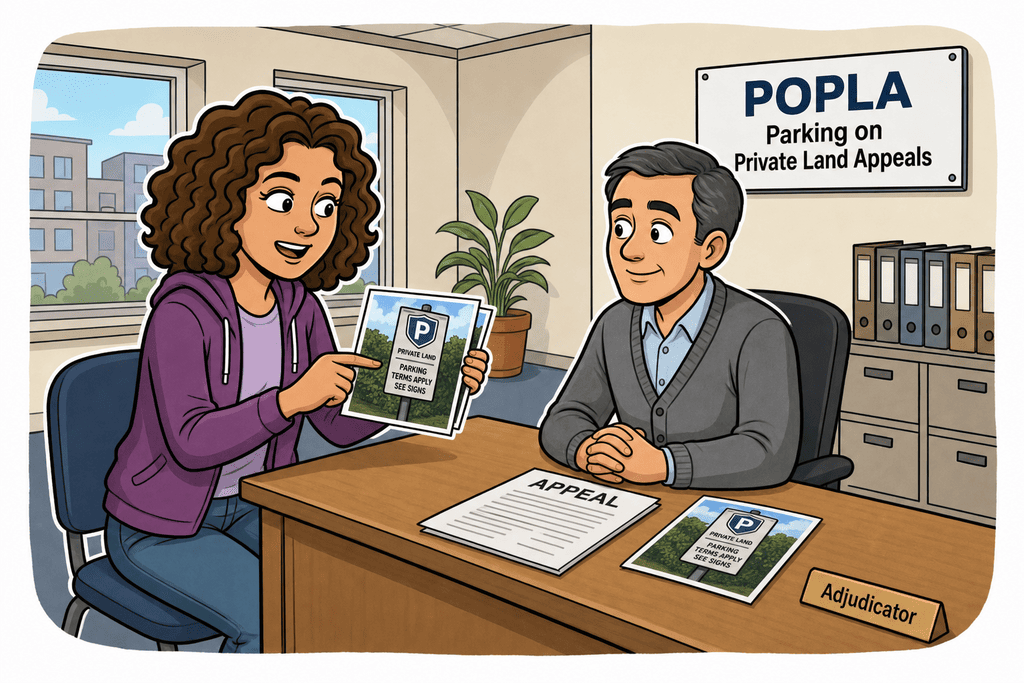
Second-stage appeals are free, paper-based, and decided on the evidence both sides file. The rejection letter must name your route and give you a verification code. BPA members → POPLA (28 days); IPC members → IAS (21 days). Both are free — but they are not equals. POPLA is well worth using: write a full appeal document, save it as a PDF with photos and upload it under “Other” rather than squeezing your case into the web form. Lead with your strongest ground (POFA failure, signage, grace period), and when the operator files its evidence pack, use your ~7 days to rebut it point by point. The IAS is a different story: forum regulars who track outcomes describe it as heavily operator-friendly, and the standing advice is to skip it (and never pay the £15 “binding” option, which would bind you) unless you have a rare slam-dunk such as a hire-car paperwork failure — see the forum playbook. Losing (or skipping) a second appeal takes nothing away from you — the operator must still prove its case in court.
-
Handle debt collectors calmly
If you hold your ground, expect letters with added “recovery” fees (up to £70) and urgent language. A debt collector has no court powers — no bailiffs, no credit file entry, nothing, unless and until a court judgment exists. The forum’s standing advice is simply to ignore the letter-chain: never phone them, keep every letter, and don’t be rushed into paying fees the courts have often refused to award. Two exceptions: if a debt letter is the first correspondence you have ever received about the charge, it is your Notice to Keeper in effect — appeal it as one; and if they have traced you to a new address, email the Data Protection Officers of both the parking firm and the collector to erase the old address, so a future claim can never be served where you no longer live.
-
Take a Letter Before Claim seriously
This is the formal pre-court step under the Pre-Action Protocol for Debt Claims, and it deserves a response within 30 days. The forum’s advice: don’t fill in the enclosed reply forms (you are not obliged to declare your finances to a parking company) — instead reply by email to the solicitor or operator, confirming your correct address for service, stating the debt is disputed and that any claim will be vigorously defended, and briefly giving your grounds. Request the documents they would rely on: landowner authority, site signage plans and photos, and POFA compliance evidence. This is also your last, best moment for a landowner complaint (“Plan A” — it still kills claims at this stage), and if the letter came from ParkingEye directly, their litigation team at [email protected] will consider evidence like receipts or a Blue Badge as a final appeal. Many claims die here when the claimant sees a prepared defendant.
-
Defend a court claim — do not ignore it
Acknowledge within 14 days (online via Money Claims / MCOL using the details on the form), which gives you 28 days from service to file a defence. Don’t write one from scratch: adapt the MSE forum’s Template Defence, editing only the case-specific facts. Grounds include: no keeper liability under POFA, inadequate signage so no contract was formed, no landowner authority, code breaches, and unenforceable add-on fees. Our case law page collects the authorities for each of these, with quotes and transcript links to exhibit. The case will be allocated to the small claims track — informal, and your costs risk if you lose is essentially the claim plus modest fixed costs. Two later deadlines to know now: the N180 Directions Questionnaire (an easy form, emailed to the court, copying the claimant’s solicitor), and — if a hearing is listed — your witness statement and evidence, due by the date on the hearing letter (usually 14 days before). The defence alone is not enough; the witness statement is mandatory. Operators frequently discontinue against a competent defence (defended claims are won around 99% of the time, per the forum’s tracking); if not, a hearing is a short conversation with a district judge, no solicitor required — and ask for your costs before you leave.
-
Get support — start your own forum thread
The MSE parking forum’s volunteer regulars have two decades of accumulated experience, current template appeals and defences, and will critique your drafts for free — the single most valuable thing you can do at any stage is start your own thread (one thread per case, don’t use your real name, redact photos) and keep everything on it. Our forum playbook explains how the forum works and what to include. For high stakes, health-related distress or anything you are unsure about, speak to Citizens Advice or a solicitor.

Common questions
Can I just ignore a private parking ticket?
It is legal to ignore one — a private charge is an invoice, not a fine — and a proportion of ignored charges are quietly written off. But the operator has up to six years to bring a court claim, and if you then ignore that, you get a default CCJ. The old “just ignore it” advice from the pre-2012 era is dangerous today, because keeper liability and cheap online litigation have changed the economics. Ignoring is a gamble; appealing is free.
Can I pay now to be safe, then sue to get the money back?
Realistically, no. Paying a parking charge is treated as settling a disputed contractual claim, and the courts will not normally let you reopen a dispute you chose to settle. There is no established “pay under protest and reclaim” route for private parking charges, so make your decision before paying. The corollary is comforting, though: the operator carries the burden of proof throughout, and refusing to pay while you appeal costs you nothing.
Do I have to say who was driving?
No — unlike speeding offences, there is no legal duty to name the driver of a privately-ticketed vehicle. That is exactly why POFA keeper liability exists: it is the operator’s only route to holding a non-driving keeper responsible, and it only works if they followed Schedule 4 to the letter. Keep your wording neutral (“the driver”, “the keeper”) in all correspondence.
Will a private parking charge affect my credit rating?
Not by itself. Neither the charge, nor debt collectors’ letters, appear on your credit file. The only thing that does is a county court judgment — and only if you lose (or fail to respond) and then do not pay within one month of the judgment.
The car park is in Scotland or Northern Ireland — does this all apply?
Partially. The clamping ban and POFA keeper liability apply to England and Wales only. In Scotland and Northern Ireland the operator can generally only pursue the driver, which changes the strategy significantly. Court procedure also differs (Simple Procedure in Scotland; Small Claims in NI). The trade-body codes and appeals services operate UK-wide.
What if I already missed the appeal deadlines?
You lose the easy routes, not your rights. POPLA and the IAS occasionally accept late appeals for good reasons (hospitalisation, post gone astray). More importantly, every legal defence remains fully available if the operator sues — missing an appeal window does not make the charge enforceable, and the operator must still prove its case in court.
The notice went to my old address and I only just found out. What now?
Act the same day you find out. If a default judgment already exists, you can apply to set it aside (form N244) on the basis you never received the claim — do this promptly, as delay counts against you. Also update your V5C address with the DVLA to stop it recurring; that duty falls on you as keeper.
Keep perspective: operators issue charges by the million precisely because most people pay without question. A calm, evidenced, deadline-respecting challenge already puts you in the minority they least want to deal with.